

Bhubaneswar : KIIT-DU is set to play a crucial role in safeguarding Asia’s unprotected Buddhist heritage. At a time when experts across India, China, Korea, and Japan are expressing concern that over 90 per cent of Buddhist heritage sites—particularly those in rural areas—remain unprotected, KIIT and KISS have stepped forward with a proactive response. An International Academy for the Preservation and Management of Unprotected Buddhist Heritage and Sites in Rural Areas is being established by the Indian Trust for Rural Heritage and Development, with Professor Dr. Amareswar Galla, Pro-Chancellor, KISS DU, providing intellectual and strategic leadership to the initiative.
Prof Galla, a distinguished Professor of Indigeneity and Inclusive Museum & Heritage Studies at both KIIT DU and KISS DU, is now working closely with the KIIT School of Law to design a specialised programme in UNESCO International Heritage Law. Once launched, it will be the first such academic programme in South Asia, positioning KIIT as a leader in heritage governance studies.
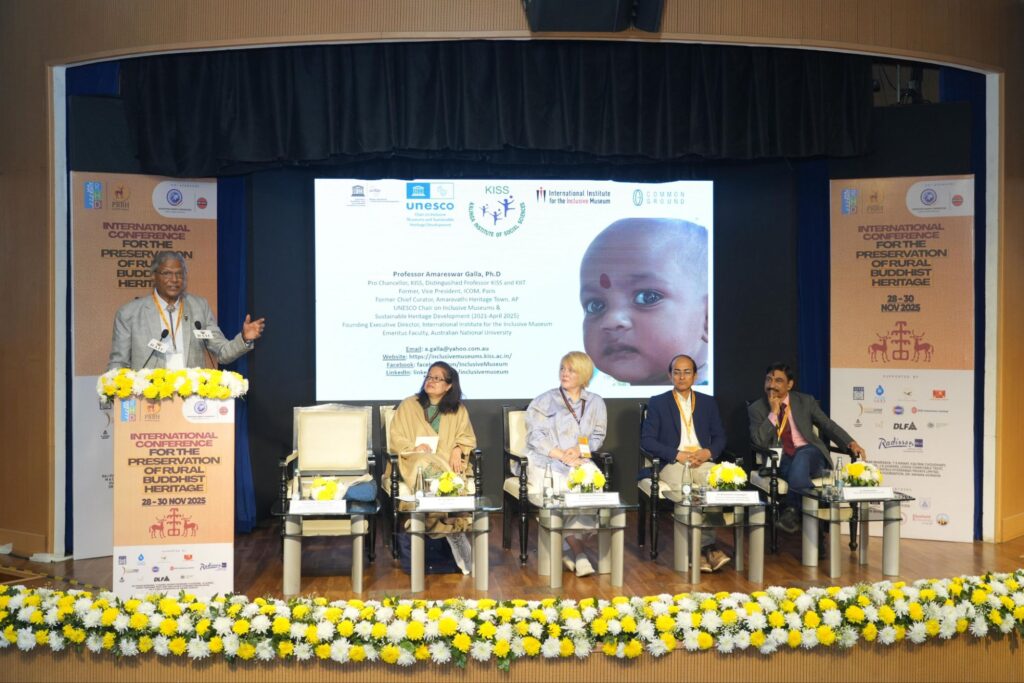
Prof Galla presented the proposal for the Academy at a major international conference late last year. Building on that momentum, a core team of global experts convened in New Delhi on 7 February 2026 to deliberate on the structure, curriculum, and long-term roadmap of the Academy.
Speaking on the sidelines of the deliberations, Prof Galla underscored the urgent need for integrated models that combine legal frameworks, community participation, and ethical stewardship to protect endangered Buddhist sites in rural landscapes.
The initiative holds particular significance for Odisha. Recently, UNESCO included the State’s renowned Buddhist Golden Triangle—Ratnagiri, Udayagiri and Lalitgiri—on India’s Tentative List for World Heritage status through a serial nomination. The proposed academic programme and the International Academy are expected to strengthen Odisha’s capacity to manage, conserve and legally safeguard these historic sites if granted full World Heritage recognition.
