
Bhubaneswar: Amid conversations around climate change and geopolitical tensions, a quieter yet deeply pervasive health concern is steadily intensifying – noise pollution. India’s cities rank among the noisiest in the world, with vehicular traffic emerging as one of the primary contributors.
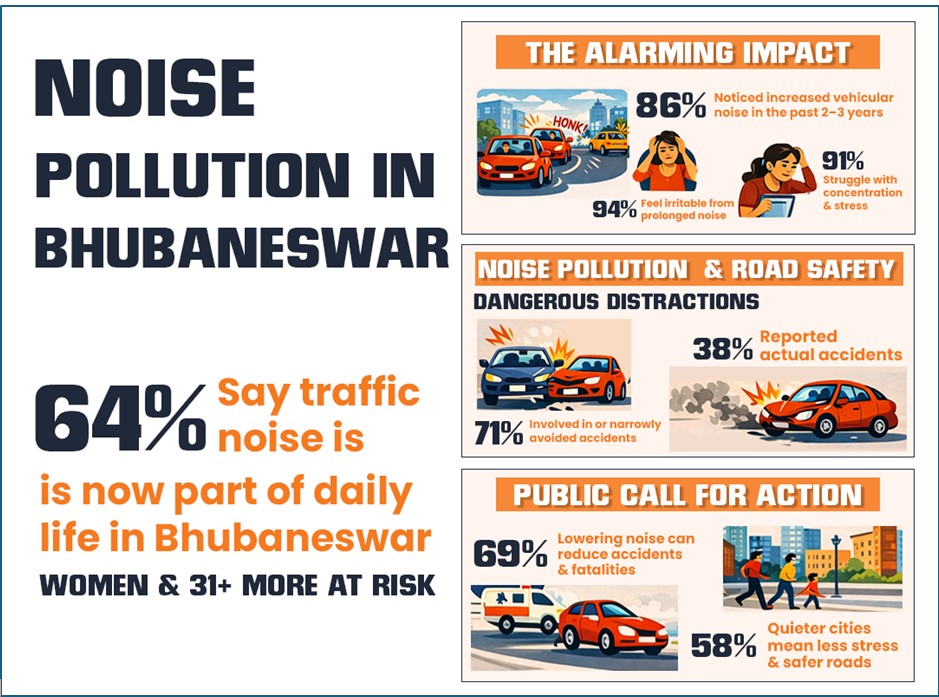
Honking horns, revving engines, and congested streets have collectively normalised a soundscape that is gradually eroding both public health and road safety. Despite well-documented risks, a recent survey by Jindal Panther in collaboration with YouGov reveals that 64% of respondents in Bhubaneswar now consider traffic noise a “normal” part of daily life. What was once an irritant has become so deeply embedded in everyday experience that it is rarely questioned. Yet this normalisation comes at a significant cost.
The findings are stark. An overwhelming 86% of respondents reported a noticeable increase in vehicular noise over the past two to three years. This steady rise reflects not just growing urban congestion, but also a behavioural shift – where excessive honking and noise are increasingly seen as inevitable rather than avoidable.
The safety implications are equally concerning. According to the survey, 71% of respondents have either been involved in or narrowly avoided an accident due to noise-related distractions. Even more alarming, 38% reported actual accidents linked to such disturbances. In high-density traffic conditions, where split-second decisions are critical, excessive noise contributes to cognitive overload, reduces alertness, and increases the likelihood of errors. In this context, noise is no longer just an environmental issue – it is a direct road safety risk.
Medical experts are increasingly sounding the alarm. Dr. Aditi Deb, ENT Surgeon at Fortis OP Jindal Hospital Medical Center, underscores the gravity of the issue: “Every year, lakhs of accidents occur on our roads. In emergency situations, when I see such injuries, many cases turn out to be hit-and-run incidents where patients even lose their lives. Unsafe or rash driving, over speeding, not wearing helmets, skipping seat belts, and ignoring road safety rules have become extremely common on our streets. Irresponsibility seems to have become the norm. The first step toward making our roads safer is to create awareness among people about how their carelessness is putting both their own lives and others at risk.”
Beyond safety, the mental health impact is significant. Nearly 94% of respondents reported feeling irritable after prolonged exposure to noise, while 91% said it hampers concentration and elevates stress levels. In fast-paced urban environments, where focus and productivity are essential, such constant auditory disruption can have far-reaching consequences.
Encouragingly, initiatives like Jindal Panther’s ‘Shaant City, Safe City’campaign are bringing renewed focus to this issue. By promoting mindful driving and discouraging unnecessary honking, the campaign highlights how small, conscious actions can contribute to calmer, safer, and more liveable cities. The message is simple yet powerful: a quieter city is a safer city.
Addressing this hidden crisis requires more than regulatory intervention, it calls for a shift in public behaviour and awareness. While stricter enforcement of noise norms and improved urban planning are critical, individual accountability is equally important. Every unnecessary honk, every moment of impatience on the road, adds to a larger collective problem- or, if addressed, can become part of the solution.